Monday, December 26, 2016

Stone "fort" of Tennessee -Open to the Public

Here's a diorama of Native Americans contructing the old stone fort down in Tennessee
https://en.wikipedia.org/wiki/Old_Stone_Fort_(Tennessee)
http://www.tnhistoryforkids.org/places/old_stone_fort


Wednesday, September 28, 2016

stone symposium 4 Oct 22nd 1 pm at Opus 40

Stone Symposium IV
Saturday October 22nd 1-6 pm

The Symposium will take place at Opus 40 , located at 50 Fite road in

Saugerties New York

More info at Opus40.org and www.hopeskillian.blogspot.com


10$ admission to Opus 40 includes entry to the Symposium


During this day long conversation concerning the extensive  native and

ancient quarrying that took place in our local area, the various
speakers will bring their expertise and knowledge to Opus 40, the
unique and important quarry based sculptural environment of Harvey
Fite, in order to shed light on how the people before us have altered
the stony landscape for purposes both functional and sacred. Once the
enormous amount of built stone structures, the mountains of stacked
stones and quarried water reservoirs that run from Saugerties up
through the  Paleolithic Flint Mines of Coxsackie and beyond are
properly looked at and connected, we may begin to sense and fathom an
earth-scaping project that took much more time then  the brief
bluestone industry would of allowed.

 featured speakers-


Glenn Kreisberg is a radio frequency engineer,  researcher, and writer

and has  edited 2 volumes of a Graham Hancock Reader including “
Mysteries of the Ancient Past”. The title of his forthcoming book is:
“Spirits in Stone: Lost Landscapes and Hidden Legacy of Northeast
America” will be published soon by Inner Traditions

Evan Pritchard  is the founder of The Center for Algonquin Culture. He

is the author of “Native New Yorkers, The Legacy of the Algonquin
People of New York”, “No Word For Time, the
Way of the Algonquin People”, and his most recent: “Bird Medicine, The
Sacred Power of Bird Shamanism” also put out by Inner Traditions

Linda Zimmermann is author of over 30 books on anomalous subjects, her

most recent is entitled “Mysterious Stone Sites in the Hudson Valley
of New York and northern New Jersey”

Teresa Bierce is a longtime investigator of local lithic curiosities

and is the Western Connecticut coordinator for NEARA (New England
Antiquities Research Association)

David Johnson is a Past President of the Orange County Chapter of the

New York State Archaeological Association. He is currently researching
stone sites in the Woodstock area, the  Chaco Canyon region of the
South West and the Nazca sites in Peru.

Matt Bua is author of the book: “Talking Walls: Casting Out the

Post-Contact Stone Wall Building Myth” which has a focus on the area
of Kiskatom in the town of Catskill.

Philip C. LaPorta is geologist and archaeologist who is executive

director of The Center for the Investigation of Native and Ancient
Quarries-(CINAQ)
schedule(subject to change)
1::15 Matt Bua intro- welcoming
> 1:45  Teresa Bierce
   2:15- Philip laPorta
> 2:45: David Johnson
> 3:30  Evan Pritchard
> 4:15 Linda Zimmerman
> 5:30  Glenn Kreisberg

Thursday, November 12, 2015

Stephen Hren's Review of Talking Walls for the Huffington Post

http://www.huffingtonpost.com/stephen-hren/book-review-talking-walls_b_8213844.html


Having been a frequent visitor to the beautiful countryside of New England, traveling a byroad or ambling along on Amtrak, it's impossible not to notice the astounding quantity of stone walls or piles that are simply everywhere. Composed mostly of grey granite, they meander hither and yon, up ridges and along ancient streams. They are rarely spoken of, or thought of much either I suppose, and there's a general sense that they were built some time by our industrious pioneer forebears, early Europeans who were clearing fields or building fences to keep their livestock from wandering off.
2015-09-29-1443534981-1162684-stonewallcover.jpg
How mind-blowing, then, to stumble upon a book such as Matt Bua's Talking Walls: Casting Out the Post-Contact Stone-Wall-Building Myth, recently published byPublication Studio Hudson in Catskill, NY. While the myth of pioneers building this colossal earthworks has a veneer of warm, fuzzy wholesomeness at first blush, Bua's closer examination of the revelant facts makes this no more likely to be true than any other fairy tale. Bua keeps the book moving through crisp prose, thankfully keeping the minutia and more detail-oriented asides in a long footnotes section. He succintly lays out many cogent arguments that point to the likely historical source of these walls being constructed over a much longer time period, and for perhaps less banal reasons than mere livestock enclosure, well before any Europeans set foot on New England's rocky shores.
2015-09-29-1443535037-8469821-widewall.JPG
Here are the highlights:
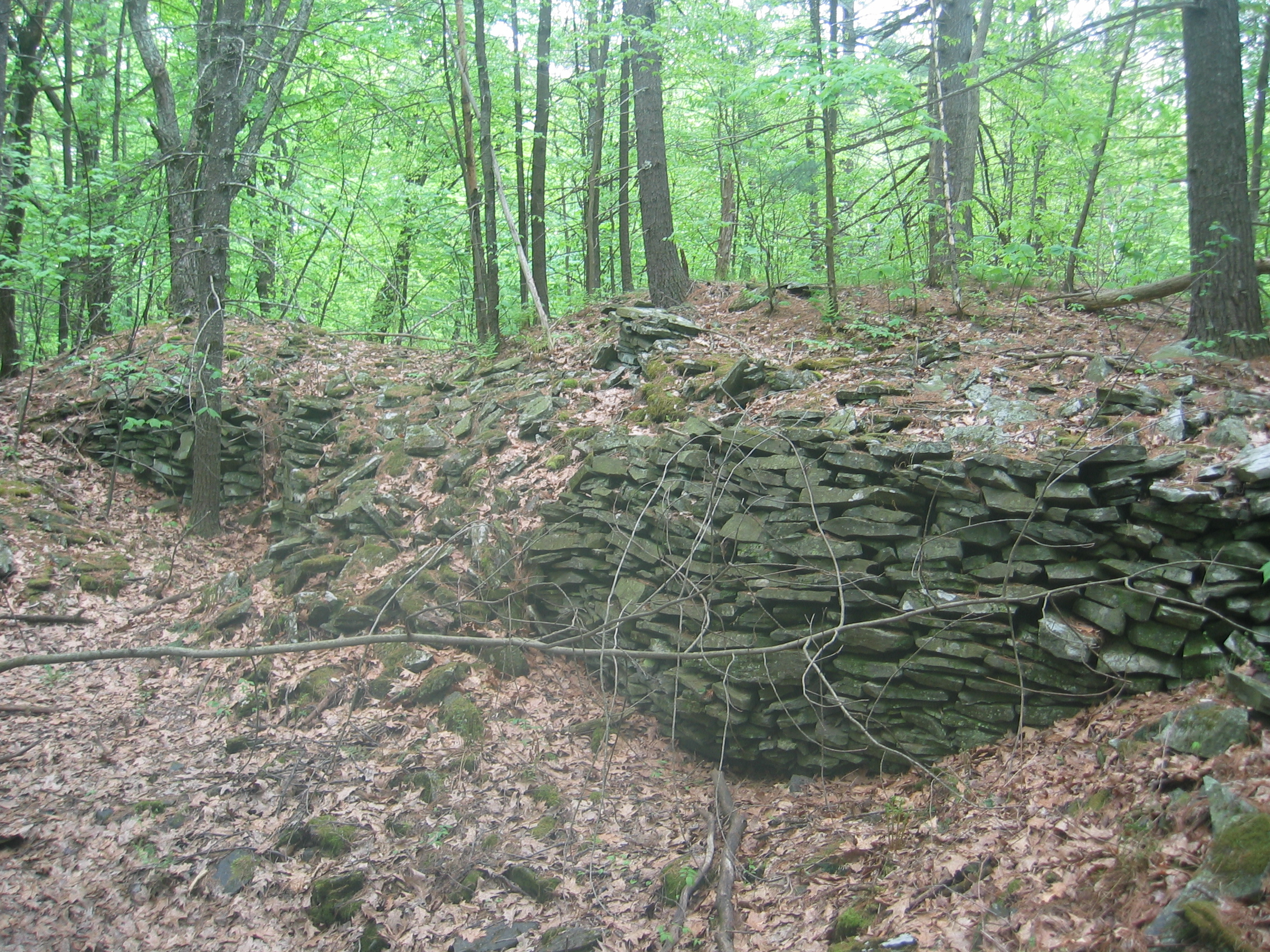
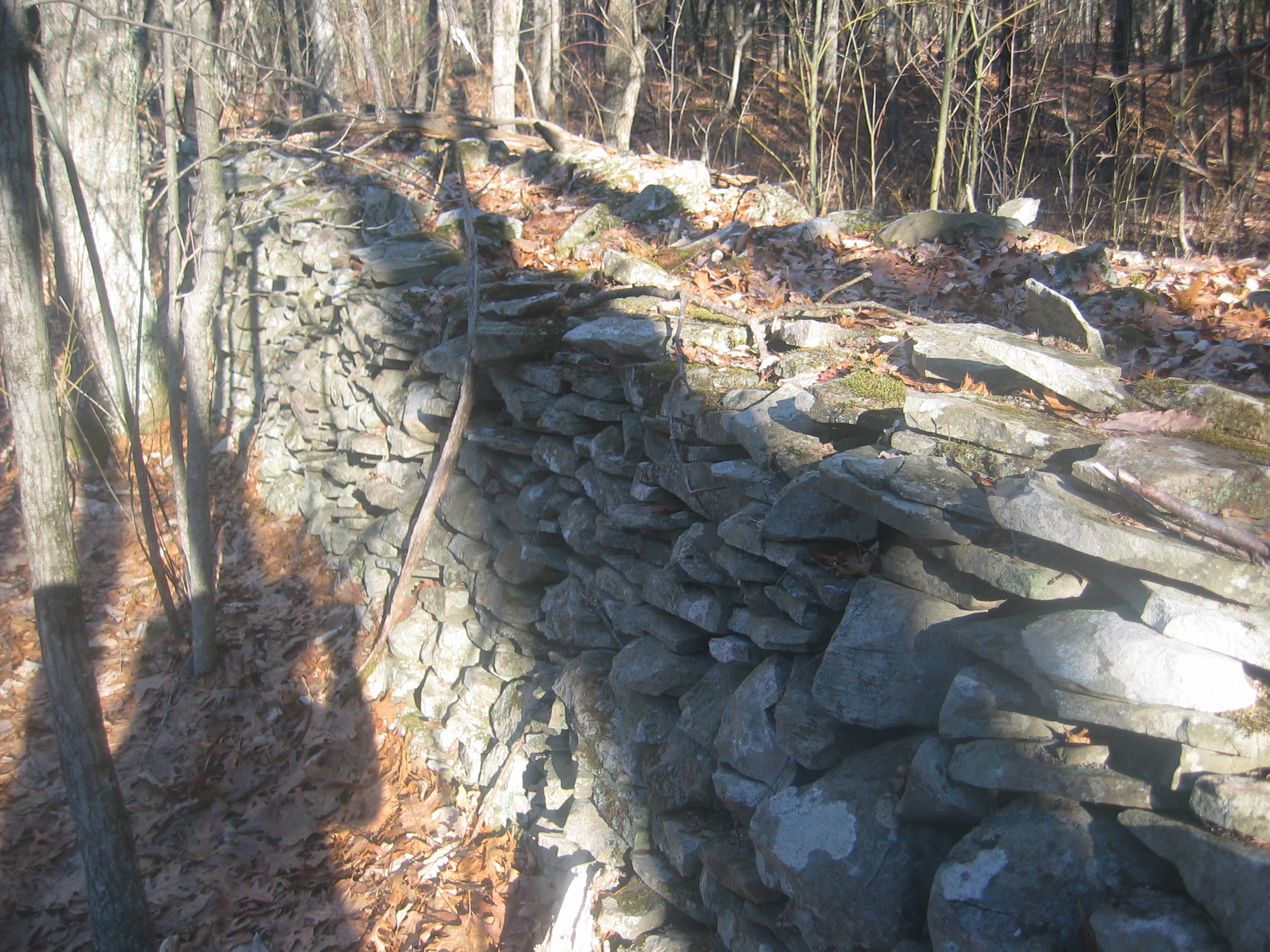
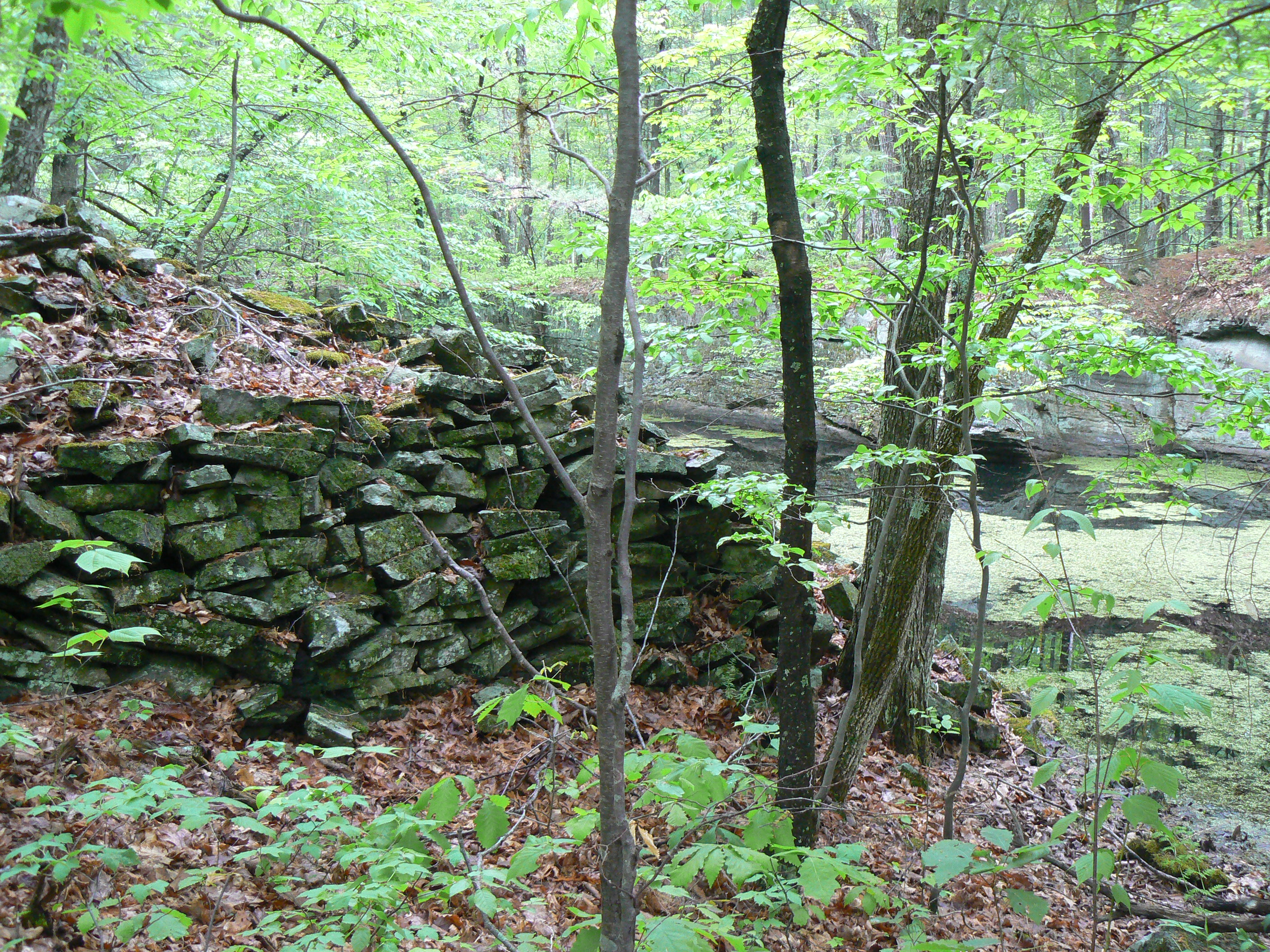
First off, when one actually looks at them, the walls make no sense as livestock enclosures or for property line demarcations. They are erratic, often meandering over mountaintops and stopping abrupting at waterways. They have numerous secondary features such as large (8' or more) cone-shaped cairns that make absolutely no sense for time and energy strapped pioneers who also had to farm, build homes and barns, chop wood, and all the rest.
Secondly, there are simply too many walls, and not nearly enough people and time in the pioneer days, to come even remotely close to having enough labor to build all those walls. Given a timeframe of roughly 250 years (1620-1870), and if the population of New England all worked on these walls continuously with one day off a week and three months off for winter, they would need to construct roughly four miles of stone walls a day, or about a foot of wall every two seconds. Hell, maybe there were a few Paul Bunyun types back then that could have busted that out...and then maybe spent their nights farming and chopping wood...but everyone? For 250 years? Folks, that ain't right.
2015-09-29-1443535130-4760379-reservoircorner.JPG
Thirdly, you would think that such a gargantuan undertaking would be written about somewhere, at least in someone's diary, at least once, right? "Alexander came down with the flu today. The sow birthed six piglets. Built twelve miles of stone wall today." But alas, no. Okay, I know what you're thinking - they were too tired to write about it. But really? No one?
So, who built them? How about the folks that were here before us? Native Americans built them. For what? Mr. Bua has lots of ideas on this score, and I'm not going to give everything away in this review. But consider the fact that elsewhere in the Americas, North and South, large earthworks and colossal structures are the norm, not the exception. And consider that New England was inhabited for ten millennia before the European colonists showed up...and then read this great book and let Mr. Bua pry your mind open to what might really have gone down with all those stone walls.
Stephen Hren's most recent book is the illustrated ribald epic Max's Hungry Ghost, available at his website: www.stephenhren.com.

Paul Smart's 'Talking Walls' review in the Saugerties Times

Excerpt from Paul Smart's review from Oct 15th edition of the Saugerties Times:

Many know of Matt Bua from his sculptural art works, such as the two
story handmade cat he constructed from found twigs and lumber in
Catskill several years ago, his wild drawings and curating/editing of
a great book about visionary architecture or B Home experiments with
building myths and new realities out in backcountry Greene County, or
even his self-made instruments and musical adventures. Nothing he's
done to date, though, properly prepares one for the deep joys, and
varied catharses, immersed in his newest book put together with
Catskill's enterprising Publication Studio Hudson.

Talking Walls: Casting Out The Post-Contact Stone-Wall-Building Myth,
which Bua will be discussing at a book launch event at Saugerties'
Inquiring Mind Bookstore starting at 7:00 PM on Saturday, October 17,
is an artist's book of a brand-new stripe. Like some classics that
begot entire fields of science in the 18th and 19th centuries, or
great explorers' memoirs, the author admits the limitations of his
curiosity-driven and chaotic methodology right from the start.

"I am not a scientist. I am an artist. My training is in connecting
seemingly disparate dots. My practice involves training my
consciousness to deal with loose ends and dancing around the
unanswerable," he writes in his own Forward. "This book is far from
anything close to a complete theory concerning the stone walls and
their builders. It is essentially just a 'stepping off' place,
considering existing explanations so each of us can experience what's
still here firsthand. There is no training or school that can prepare
one for this, just the desire for anything and everything to happen
with splendor and grandeur."

What results, care of new Creative Commons licensing allowances, is a
mash-up of materials always based on Bua's in-the-field walks and
ramblings, his deep observations and ruminations about all the stone
walls throughout our greater region. He starts with a shake of the
head -- is there really any way this could have all been done by
settlers while pioneering and farming and raising families and
starting communities? Then he shows off all he's found in the woods,
in books, in ever-widening gyres of research, and finally his own
mapmaking and creative conjurings.

Who cares, in the final round, what's truly true? THis is a book of
voyaging and making history, and the world, one's very own.

Wednesday, August 5, 2015

Old Stacked Stones and Dead Soldier

Looking through a friend's book "The American Civil War: A Visual Encyclopedia" I ran across this photo on page 105. Was this something he threw together to be used as a blind or was it already there?

Saturday, August 1, 2015

'Ancient Paving" at Pemaquid Maine


The Caption says" Ancient cellars and pavement have been excavated on the site which may go back as far back as the Fifteenth century" or much, much further. Source :Album of American History:Colonial Period1943 p 64

Livingston Manor- 1714 John Beatty Map--Lots of References to Native American Stone heaps


Friday, February 13, 2015

Presentation at N.E.A.R.A's spring conference on April 24th in Kingston NY

I'm pleased to announce that I will be presenting Friday eve at 7pm on April 24th at the conference.

for more info- www.neara.org

Spring 2015 Conference

NEARA SPRING 2015 CONFERENCE, scheduled for April 24th - 26th at 
the Quality Inns & Suites in Kingston, NY.

Invited speakers include :
Michael Gramly - President The American Society for Amateur Archaeology  
David Johnson - Past President Orange County Chapter of the NYS Archaeological Association
Matt Bua - Artist/Author/Director - The Stone Symposium
Donald Aubrey - Land Surveyor and Native American researcher
David Schewe - School teacher and NY Native American site researcher
Laurie Rush - Cultural Resource Manager - Fort Drum, NY

Plus much more including: Fri. & Sun. Field Trips, Exhibits, Book Sales, Members Banquet and Raffle!

Friday, November 28, 2014

Stone Symposium III- Saturday, December 13th

2 Presentations and Book Launch

Glenn Kreisberg: Mission Malta- Exploring the Sound and Energy Properties of Ancient Architecture

Matt Bua- The Mapping of a Prehistoric Stone Site in Catskill NY
Book Launch
Talking Walls: Casting Out the Myth That All Stone Walls of the North East Were Built Post-Colonially
8 pm
at Print.Studio. Hudson in Catskill
460 Main Street Catskill NY 12414
free and open to the public
more up to date Print Studio news can be  seen:
www.facebook.com/pubhudson
Glenn Kreisberg; editor of the Author of the Month page at GrahamHancock.com, is a radio frequency engineer, writer, researcher, and licensed outdoor guide and currently serves as the vice president of the New England Antiquities Research Association(NEARA.org). The author of numerous articles and papers, including Lithic Mysteries of the Northeast, he is the founder and editor of the alternative science and history website ASHnews.org. He lives in Woodstock, New York, with his wife and two children.

Wednesday, July 16, 2014

Upcoming Lectures

Sunday, September 28th, 2014
at the Bascom Lodge
Talking Walls - Casting Out The Myth That All Stone Walls Were Build Post-Colonially, with Matt Bua"
In The Lobby At 6pm, Event Is Free
The dry stacked stonewalls focused on in this lecture do not enclose land, are built on massive foundations (ruling out field clearing piles) and terminate at streams and marshes.  Many exist where land has not been cultivated in the past.  An array of uncontested North American ancient stonewall complexes will be presented as well as correlations to stones walls and their usages from around the world. 


Directions

Some spring 2014 shots

Cairn on ground
Embrasure in Wall Surrounding Notched Boulder

Saturday, December 7, 2013

December 7th 2013 Stone Symposium II

Save the Date: Dec 7th at the Catskill Community Center 344 main st Catskill NY 12414

Presentations By:


Glenn Kriesberg:
Lithic Alignments in the Northeast, Natural, Native or Nonsense

Polly Midgley:
Enigmatic Stone Chambers in Westchester, Putnam and Dutchess Counties

Matt Bua:

When Walls Talk- (Casting out the Myth that all Stone Walls were built Post-Colonially)


Tuesday, September 3, 2013

Kiskatom Land patent Map from around 1767 which reference stone work

Marked with green are all the references to existing stone work, walls including a pile and an "old ditch"
Hopefully the resolution is high enough. Lots of info on this thing


Thursday, January 31, 2013

Great In-depth West-Central Texas Cairn Website


Area ranchers typically have referred to these large cairn clusters as “Indian burial grounds” http://www.texasbeyondhistory.net/cairn/index.html
Thanks -Tim MacSweeney at Rock Piles